

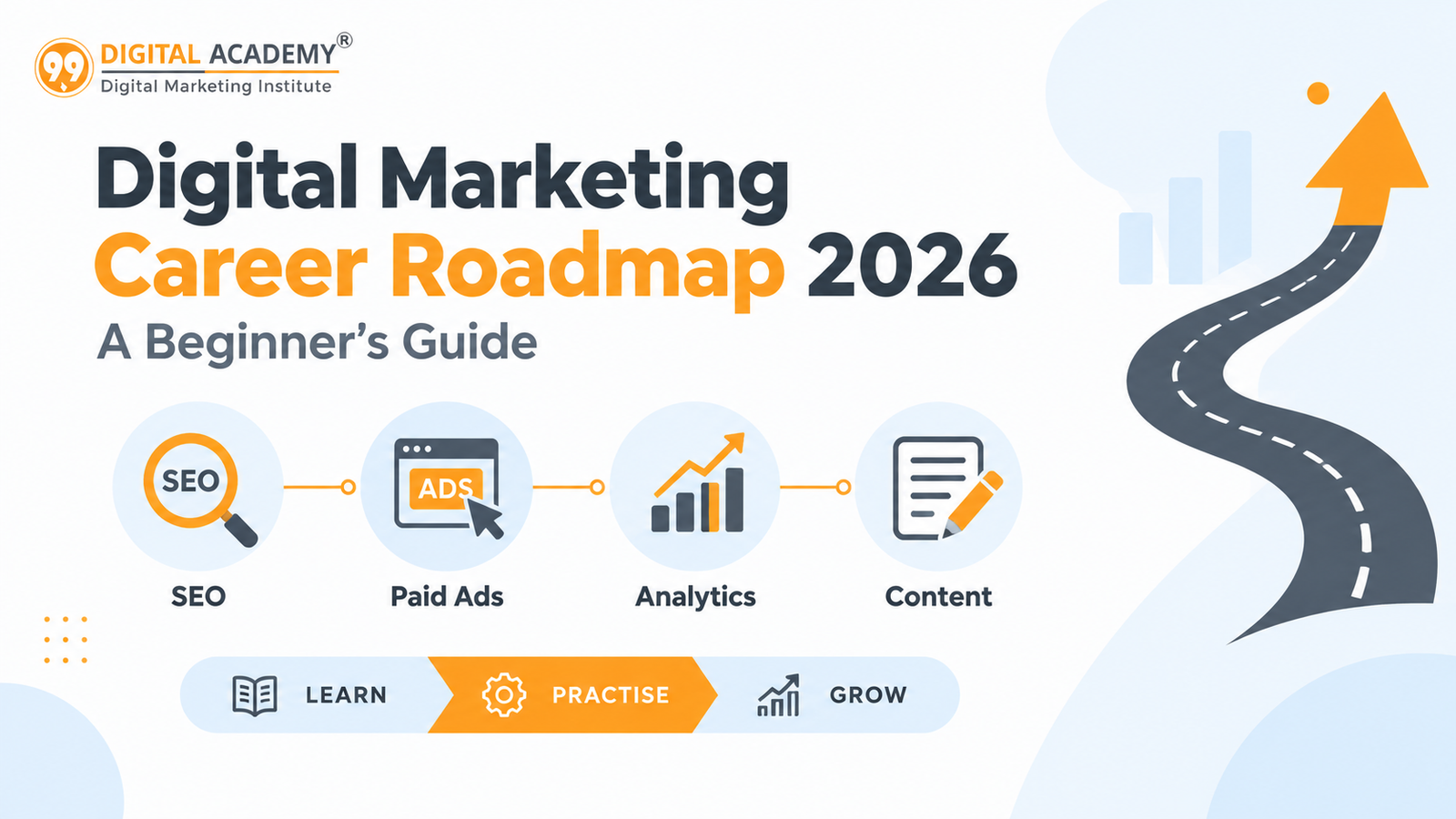
Digital Marketing Career Roadmap 2026 for Beginners
If you’re thinking about a digital marketing career, you’ve probably noticed how noisy the internet is about it. Someone on YouTube says SEO is the only thing that matters. Someone else says learn Meta Ads and you’ll have a job in a month. Then there’s the group claiming AI tools have changed everything. After an evening of watching all this, most beginners know less than when they started.
So here’s a plainer digital marketing roadmap for students, freshers and people changing careers. It covers what to learn first, which tools deserve your time, how to show your work to an employer and how to go after your first internship in 2026. You don’t need to learn everything. You just need to start in the right order.
What Does a Digital Marketing Career Involve?
Digital marketing means helping a business get seen online by the people and then encouraging some of them to ask questions make a purchase or sign up. You usually use search engines, websites, social media, email and paid ads to do this.. The real work isn’t, about the channels themselves. It’s about understanding who the customer really’s what messages will speak to them and whether what you did actually made a difference.
Think of a coaching institute in your city that wants more admissions. Its course pages might be confusing. Nobody may have written anything that answers the questions parents type into Google. The Instagram page might go silent for weeks, and even if there’s an enquiry form, nobody is checking how many people fill it. A fresher may get to work on just one of these problems at the start, which is fine, but it helps to see the full picture so that each skill makes sense.
Digital Marketing Roadmap for Beginners: Step by Step
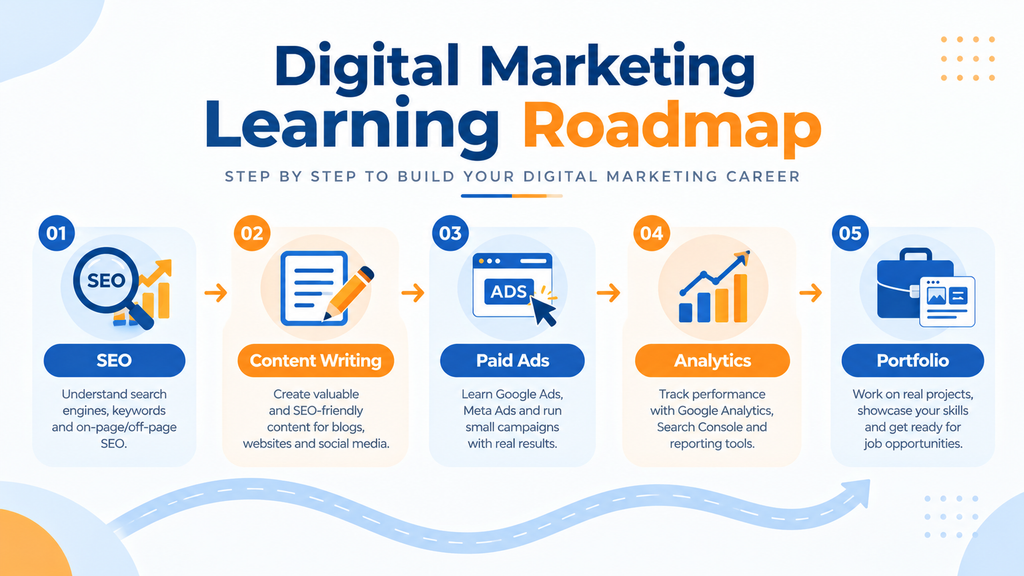
Step 1: Learn the Basic Ideas Before the Tools
Spend a few days thinking about the words: organic traffic, paid traffic, leads, conversions and return on investment. Don’t focus on memorizing them. What matters more is understanding why each of these channels exists. SEO brings people who are already looking for something. Paid ads can get in front of those people quicker. You pay for every click. Content helps build trust over time.. Social media keeps a brand visible day, after day.
Then try this. Choose a local business, maybe a gym or a tuition centre, and go through its website and social pages as if you were a customer. Write down three things you’d change. Even this small exercise teaches more than most introductory videos.
Step 2: Build Core Digital Marketing Skills
You won’t master everything, and you don’t have to. Just understand what each area asks of you. These are the digital marketing skills I’d look at first.
SEO
Keyword research, search intent, title tags, meta descriptions, headings and internal links are the starting points. Of these, search intent gets ignored the most. A person typing “digital marketing course fees” wants a different page from someone typing “what is digital marketing”, and a page that tries to serve both ends up serving neither. To practise, pick any blog post and ask whether the title fits the topic, whether the page really answers the question and whether a reader could easily find a related page.
Content Writing
Good content answers a question clearly. You research, plan your headings and explain things so that a first-time reader can follow along. Putting a keyword in every second line doesn’t help anyone, and it makes the page tiring to read.
Paid Advertising
Learn about campaign goals, audience targeting, budgets ad copy and landing pages. Start with sample plans, on paper—don’t use your money. One early lesson to remember: cheap clicks mean nothing if no one asks questions.
Analytics
This is the skill that sets apart people who just post from people who actually improve. Learn to read traffic numbers. See which pages bring in enquiries. Then explain what the numbers mean in simple words.
Read Also: SEO vs Google Ads: Which Should You Learn First?
Step 3: Get Hands-On With a Few Tools
Knowing the name of a tool isn’t the same as using it, so pick a few and go deep..
- Google Analytics 4 shows how people reach a site and what they do there.
- Google Search Console shows impressions, clicks, search queries and indexing for a website.
- Google Ads lets you practise keyword planning, campaign structure and ad writing.
- WordPress lets you publish pages and posts and edit headings.
Search Console and Analytics only show data once you have a website, so start a small WordPress blog of your own. Google also has free learning material for Ads and Analytics, which is a safer place to begin than a random playlist.
Read Also: How to Learn SEO from Scratch: A Beginner’s Guide
Step 4: Make Projects and Put Them in a Portfolio
Many beginners finish a course collect a certificate and then freeze when an interviewer asks, “What have you worked on?” Fix that with three small projects. You could research keywords for a business optimise one blog post properly audit a small website’s on‑page SEO or plan a sample Google Ads campaign with keywords ad copy and a landing page idea.
For each one note the goal, what you did the tools you used and what you’d recommend next. If you have results include them and say where they came from. If it was practice say so. Never make up traffic or lead numbers. Then collect your work in one place whether that’s a Google Doc, a slide deck or a simple website. A single well‑explained project will do more for you than a list of tools, on your resume.A structured digital marketing course can help beginners understand these skills and learn through practical projects.
Choosing a Specialisation in Your Digital Marketing Career
After a projects you will start to notice that some tasks feel easy to work with and others feel like they take forever. Focus on that feeling of trying to get a salary number that you saw somewhere. People who enjoy digging into information and solving problems usually like SEO. If you like working with numbers and trying things look into Google Ads and analytics. If writing is something you’re good, at start with content marketing. If you are creative try media. Whatever you choose first you can always change it later.
Applying for Your First Internship or Job
Once you’ve got the basics down and have done a small projects it’s time to start applying for jobs. You’ll often see job titles like Digital Marketing Intern, SEO Intern, Junior SEO Executive or PPC Intern. Take your time to read each job description.
One company might be looking for someone who focuses mostly on SEO while another wants someone who can manage media and paid ads. If you match most of the requirements go ahead. Apply. Use the parts you don’t know as a list of things to learn.
In interviews talk about your work using words. Explain how you chose keywords or what you noticed when checking a page, in Search Console. If you don’t know something just say so. It’s better to be honest than to pretend or guess. Being honest shows that you’re willing to learn and grow.
How AI Fits Into Digital Marketing in 2026
AI tools are helpful, for coming up with ideas going through research and putting together outlines. They can also give wrong information and write dull run-of-the-mill content. That means everything they create needs your review and your own real examples. Start by learning the basics yourself then use AI to help. Because no tool can truly understand a business problem the way you can.
Final Thoughts
A career in marketing doesn’t begin with a course. It begins when you learn the basics pick up some marketing skills and show what you can do through projects. Think of it like this—, over three months start with the fundamentals then jump into hands-on projects build your portfolio apply for opportunities and move at a pace that fits your life.
What happens next depends on how much you practice, the feedback you get from others and the roles you want to reach. So view this marketing plan as a starting point, not a guarantee. At 99 Digital Academy we help new people measure their progress by what they can do.
FAQ
1. What does a digital marketing career actually involve?
Basically, you help a business get found online and get a few of those visitors to call, buy or fill in a form. Search, content, social media, email and ads are the usual ways to do that.
2. Which skills come first?
SEO, writing, paid ads and analytics. Don’t try to master them all in month one. Just get a feel for what each one demands.
3. What’s search intent?
It’s what a person really wants when they type something into Google. Someone searching “digital marketing course fees” is close to buying. Someone searching “what is digital marketing” is still just curious. They need very different pages.
4. How do I choose what to specialise in?
Do a few projects and notice which part you don’t mind spending hours on. That’s usually your answer, and you can always change your mind later.
5. What should I search for on job sites?
Digital Marketing Intern, SEO Intern, Junior SEO Executive and PPC Intern. Read each description closely, since two “digital marketing” jobs can be quite different.
tag:
Share:

Pankaj Kumar