


Keyword Research: How to Discover What Your Customers Really Want
Look at any beginner’s blog and you can usually guess what happened. They picked a topic they liked, wrote it nicely, and published. Then they sat back and waited for Google to do the rest.
“Google didn’t. And honestly, why would it? Nobody had searched for that topic in those words.”
This is the gap keyword research fills, and it’s smaller than people think. You’re not cracking a code. You’re just checking what people type when they need help, so your page uses the same language. Let’s walk through how to do that without any fancy jargon. “Learning the right skills through a Digital Marketing Course in Dwarka Delhi can help beginners understand SEO, keyword research and other important areas of online marketing.”
So What Is Keyword Research?
Understanding what search terms people are searching for and what they are looking for.
What makes keyword researching such an interesting part of SEO is that depending on what search terms you choose will depend on who you’re targeting. For example if you target ‘how to start a blog’ and ‘best web hosting for blog’ you’re targeting two very different people. One person is unsure whether they should start blogging and another is looking for the best deals. Writing one page for both people will likely lose you both.
Good keyword research for SEO is not about getting the highest number of searches but knowing who is searching for those terms and what they are looking for.
Don’t Skip Search Intent
Your search intent is simply the reason people have searched for your keyword. People could be searching for information (What is SEO keyword research?), looking to compare options (Best keyword research tools), looking to go to a site (Login to Google Search Console) or take action (SEO course in Delhi).
Just do a quick Google search for your keyword. If you see lots of blog articles on page 1 then people are looking for information. If there are lots of courses or products then people are looking to make a decision. Google will have picked up what people have been clicking on and will provide results based on what people are looking for. You will never argue with Google!
Many beginners fail to realise this. They find a high volume keyword and produce an in-depth guide to only find out the whole first page is full of shops. Beginners who want to develop practical SEO skills can explore an SEO Training Course to understand keyword research, search intent and other important SEO techniques.
How to Find Keywords (Without Spending Money)
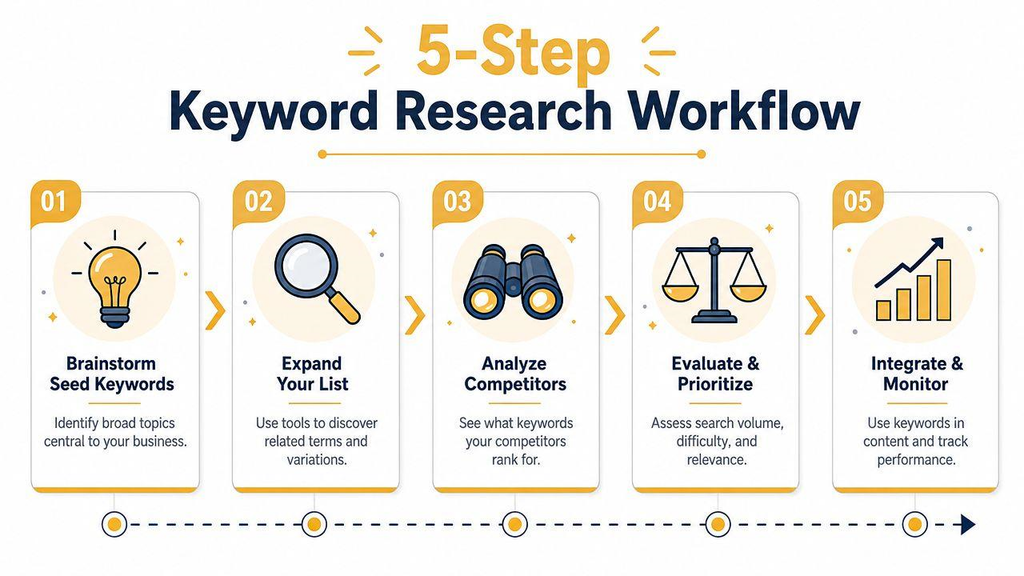
You don’t need paid software on day one. Here’s a simple order that works.
Go Straight to the Source
Go straight to the source! Look through your WhatsApp, enquiry forms, Instagram comments, etc. This will give you an idea of what people are asking about. Write down any questions that come up often. They will probably not use the exact wording you are looking for. For example a student may search for a ‘computer course with job’ rather than digital marketing certficiation.
Use Google
Use Google. Type in a search term and don’t click enter. Look at the auto-suggestions. These are real people searching for this term. Then look at the People Also Ask section and related searches. All of this is free.
This is where you will find long tail keywords. These are longer search terms such as ‘how to do keyword research for a new website’. These won’t be searched for by many people but those that do will know exactly what they need. You are more likely to rank for these on a new website.
Use a Tool
Use a tool. Once you have a general list of keywords you want to target, using a tool will help you decide. Google Keyword Planner is free if you have a Google Ads account. It will give volumes and related ideas. Google Search Console is also free and shows which searches are bringing traffic to your site. Google Trends is useful for seasonal topics. Semrush/Ahrefs/Ubersuggest are paid for but some have limited free usage. They provide additional features such as difficulty ratings and competitor keywords.
Just remember that these are approximations. Different tools can show different numbers. Use them to compare keywords.
Look at Who Is Ranking
Look at who is ranking. Open up the top couple of results and see if they are large brands or smaller sites like yours. Is the content detailed or could you improve? If it seems too difficult then try being more specific with your search term. ‘Keyword research for small business websites’ would be a fairer fight for a new blog than ‘keyword research’.
look at who’s already ranking. Open the top few results. Are they big brands or small sites like yours? Is the content thorough, or can you do better? If it looks too tough, make your phrase more specific. “Keyword research for small business websites” is a fairer fight for a new blog than plain “keyword research”.
An Example to Make It Real
Let’s imagine that Neha is a mehndi artist who has just launched her own website. She wants to attract more bridal bookings for her mehndi art work. To begin with she Look at who is ranking. Open up the top couple of results and see if they are large brands or smaller sites like yours. Is the content detailed or could you improve? If it seems too difficult then try being more specific with your search term. ‘Keyword research for small business websites’ would be a fairer fight for a new blog than ‘keyword research’.
thinks that targeting the search term ‘mehndi design’ will increase traffic to her website.
When she searches for the search term ‘mehndi design’ on Google, she can see that most of the results are galleries, designs and popular websites. The people searching this keyword are looking for inspiration.
She decides to search for a little more specific keyword. When she searches ‘bridal mehndi’ on Google there are suggestions for booking and price. She can see that there are questions in the People Also Ask box about when to book a mehndi artist, how long the colour lasts and how much bridal mehndi costs.
Looking at her Instagram messages she can also see that many of the brides are asking similar questions. They’re asking if she books for sangeet functions, what is the price and also availability.
Now she knows what her potential customers are looking for. She uses Google Keyword Planner to check what keywords she can target. She can see the relevant search terms that people are searching.
She creates a services page targeting the search term ‘bridal mehndi artist in Jaipur’. She also creates a blog answering some common questions about when to book a mehndi artist. The questions that customers are asking are used as headings.
What’s interesting to note is that Neha didn’t have to find any hidden keywords to improve her strategy. She just listened to what her customers were asking.
This is how keyword research helps you reach the correct audience for your business.
A Quick Way to Compare Keyword Types
| Keyword Type | Example | Competition | Best For |
| Short-tail | keyword research | High | Long-term awareness |
| Long-tail | how to find keywords for a new blog | Lower | Early wins |
| Local | SEO course in Delhi | Varies | Local businesses |
Treat this as a rough guide, not a rule. Always check the real results for your own topic.
Mistakes Worth Avoiding
Using a keyword with high search volumes that is not relevant to your users.
Avoid targeting highly competitive keywords when starting out. Begin with some low volume keywords.
Over optimising your content will result in very robotic content. Aim to include your primary keyword once in the title, once in a heading, once in your introduction and a couple of times throughout your body content.
Always carry out regular keyword research. Users habits will change over time so keywords you may have used last year may no longer be relevant. Try not to rely completely on keyword tools as they are just estimations. You know your customers better than any software!
Read Also: Top Digital Marketing Skills to Learn in 2026
Final Thoughts
Keyword research should be viewed as a listening exercise. Having an understanding of what people are searching for will make it much easier to produce useful pieces of content.
Start with one topic to begin with. Ask your audience, check what Google suggests and use a couple of tools to confirm. After doing this a few times, you will get the hang of it. This is a core skill and will underpin many areas including SEO, content writing and pay per click. Getting used to doing this will help you in the long run. “To learn more about digital marketing and its practical applications, visit 99 Digital Academy.”
tag:
Share:

Pankaj Kumar